Monday, July 20, 2020

An overview of the current situation--- July 2020


On February 24, 2020, the S&P 500 hit a new high at 3380. Once the Corona virus hit, on March 20, 2020, the S&P shed a third of its value to 2304. On March 23, Jerome Powell and the Fed announced to respond to the situation through stimulus— a stimulus greater than the Federal Reserve’s response to the last financial crisis a decade ago.

By July 16, 2020, the S&P reached 3215, close to its former high in February. The 33% decline from the record high to the crisis low took less than five weeks, and the 44% recovery to the June 8 high— took only 11 weeks.

The stock market, along with credit markets began a rally and fluctuations which shows irrational exuberance.


The most frequent questions asked are, “why isn’t the stock market reflecting economic reality and the crisis?” After all, with riots across the world, and the virus; and with retail, hotel, and tourism industries hit so badly, how is the rally still possible?

Pershing Capital’s Bill Ackman has responded along the lines of— the S&P 500 consists of technology and other sectors which were more resistant to the pandemic because they had strong balance sheets and business models. The weighted average pulled up the entire market, where as hotels and retail got hammered but made up a smaller part of the index. 

I am more pessimistic and I don’t believe Bill Ackman’s thesis. I side with Jim Chanos his bearish thesis— companies such as Zoom, pharmaceuticals, are getting ridiculous multiples and will eventually have to come back to earth from its crazy orbit. I don’t believe in this crazy rebound during a pandemic which has brought the worst economic contraction in the last few decades. I just don’t know when reality will kick in, and I truly believe no one knows exactly when.

Investor should ask:

How much money is there? And where is it going?

So how much money is there?   Too much to ignore.

Federal Reserve Chairman Jerome Powell promised to “provide as much relief stability as we can.” In June, the Fed has dropped interest rates to zero, begun buying Treasuries and mortgage debt, and started an array of lending programs. When the Fed buys securities, it puts money into the hands of the sellers, and that money has to be reinvested. The reinvestment process, in turn, drives up the prices of assets while driving down interest rates and prospective returns.

The Fed’s buying is not based on value, high prospective returns, strong creditworthiness to protect it from possible defaults, or adequate risk premiums— its goal is to keep the markets liquid and capital flowing freely to companies. The Fed said it would provide an additional 2.3 trillion in loans, including those for mid-sized companies and aid to states and cities. 

What’s scary is a lot of companies are being saved discretely under a “repurchase” or REPO market. This is private so it won’t trigger any panic among the public, and it can bring liquidity not only to domestic companies, but international ones also. Central Banks and the Federal Reserve are concerned with saving the economy, even if it means prices that overstate financial reality. All told, the Federal Reserve is now near 750 billion, supported by 75 billion from taxpayers, to help large companies survive the pandemic—all part of its 2.3 trillion rescue package.

It’s hard to deny the correlation between Fed liquidity, interest rates, and stock prices.


Where is the money going?

Money has rushed into CDs, savings, checking, money market and other cash equivalents at a record pace.

How do we know? The M2 money supply, which tracks money in CDs, savings, checking, money market, etc., has never before spiked that quickly and that high (see below).


Investors pulled money out of stocks and put it into cash or cash equivalents. In times past, this kind of behavior was usually seen at major bottoms (with the exception of 1982 and 2001).

Who is swimming naked in a rising tide?

The Federal Reserve is actively pumping lots of money into the system, and there’s plenty of cash on the sidelines. Many bright minds claim that trillions in stimulus is not enough to restart the post-corona virus economy, and they may be right. But there’s a difference between the stock market and the economy.

As the experiment with quantitative easing in 2008 and thereafter showed, the Fed is content to just inflate the stock market and wait for the economy to catch up many years later.

The stock market’s initial response to Federal Reserve liquidity is not surprising. A retest of the March panic low is still possible, but stock market returns for the remainder of 2020 and 2021 are likely to exceed expectations.

Indeed, securities prices could rise further from today’s lofty levels, making the decision to hold cash even more painful, but I am not going to go astray from the fundamentals of buying at reasonable prices. Easy borrowing, and capitalism without the consequences is like believing in the after-life without hell.

In a time of exuberance, many companies get listed, and a lot of fraud gets unnoticed (if you read the papers, look at the Wire Card situation in Germany and the Chinese Coffee company Lucking Coffee). In bad times, companies get sober and they fix things up.

The higher the market goes, the more people believed that Central Banks and the Fed can keep propping the market up.  Everyone is convinced that interest rates will be lower for longer— Fed Chairman, Jerome Powell announce on June that there will be no rate increases through 2021.

Interest rates, or the cost of borrowing, are like gravity. The lower the rate, the lower the discount rate used by investors, since the U.S treasury bonds is the safest investment for the given risk, and thus is called the risk free rate—it is a risk alternative investment when weighed upon other investment opportunities. Without such as safe haven, investors are forced to invest elsewhere. With lower and declining rates, present value of future cash flows are higher, and asset values get inflated.

Therefore if the Federal Reserve buys debt that has just been downgraded to junk, it is likely to lift the price of those bonds, and the price of other non-investment grade debt is likely to follow. Lower yields on bonds, means that investors naturally shift to stocks. People just don’t want to miss out.
Even before the pandemic, blue chip companies have been big borrowers, and few companies have been able to resist the lure of leverage. 

“Not only is the volume of debt high,” said Fed Chairman Jerome Powell last May, “but recent growth has also been concentrated in the riskier forms of debt. . . . Among investment-grade bonds, a near-record fraction is at the lowest rating—a phenomenon known as the ‘triple-B cliff.’ ”

Powell was referring to the fact that a large number of companies’ bonds were dangerously close to junk status. “Investors, financial institutions and regulators need to focus on this risk today, while times are good.” 

Powell has stopped preaching. Facing the frightening prospect of widespread corporate insolvencies, the Fed on March 23 announced a credit facility designed to support the corporate bond market. Two weeks later, the central bank stunned Wall Street by saying it would go into the open market to buy some junk bonds as well as shares in high-yield bond ETFs. 

In the last two months alone no fewer than 392 companies have issued $617 billion in bonds and notes, piling on still more debt that they may not be able to pay back.

  
Below is a chart from the Forbes article.

According to a Forbes investigation, which analyzed 455 companies in the S&P 500 Index—excluding banks and cash-rich tech giants like Apple, Amazon, Google and Microsoft—on average, businesses in the index nearly tripled their net debt over the past decade, adding some 2.5 trillion in leverage to their balance sheets.

The analysis shows that for every dollar of revenue growth over the past decade, the companies added almost a dollar of debt. Most S&P 500 firms entered the bull market with just 20 cents in net debt per dollar of annual revenue; today that figure has climbed to 38 cents. 

Once the coronavirus pandemic hit commerce worldwide, the tide was briefly gone, and we got to see who was swimming naked—revenues have evaporated, but their debt still remained. The Fed has created irresponsible money through easy financing, and bond issuance that are more than oversubscribed.

Irresponsible companies are able to refinance their debt and stay alive when they’re supposed to be dead, regardless of how bad their financial condition have been.

For example, Hertz used to be the darling of the rental car industry and way ahead of Avis. Carl Icahn, the corporate raider wanted to go in and shake things up, and since 2014, they’ve been on their 4th CEO. Even Icahn in the end couldn’t stop the inevitable chapter 11, and additional equity raised in bankruptcy would just go to creditors and end up being scrap paper. Investors aren’t prudent and it shows you how much irrational behavior exists right now with retail investors and millennial Robinhood traders.

While many countries have had strict bans and shutdowns, many, such as Hong Kong and Japan, have experienced major relapses. Until there is a cure or vaccine, reopening the economy always triggers a relapse. Actual GDP declines are on the order of 20-35% and in most countries, unemployment has surged.

A bounce from the depressed levels of late March was warranted at some point, but it came surprisingly early and quickly went incredibly far. The S&P 500 closed last night at 3,113, down only 8% from an all-time high struck in trouble-free times.

As such, it seems to me that the potential for further gains from things turning out better than expected or valuations continuing to expand doesn’t fully compensate for the risk of decline from events disappointing or multiples contracting. I have skimmed over a lot of companies and I can’t find too many compelling ideas after the quick recovery of the financial markets from Corona virus.


The aggregate market cap of 5000 companies to U.S GDP is at an all-time high. Even higher than before the 2000 and 2008 crash.  Big declines may lie ahead for GDP and earnings.


The yield curve has inverted. Long term bonds, which are supposed to yield more due to the risk of increased time until maturity have yielded less than short term bonds. But while the U.S has not issued negative interest instruments, interest rates are ridiculously low even before the Corona virus.

I am no macro-economist. I am not sure how the market will play out. 
Everyone is trying to be intelligent. I’m just trying not to be stupid.


Tuesday, July 14, 2020

Concentrated Investment Portfolios

Taken from: https://www.maynardkeynes.org/concentrated-stock-portfolios.html

John Maynard Keynes proposed that investors should hold concentrated investment portfolios.
In 1938 he described the principles he believed should underpin this style of investing. These are:
  • A careful selection of a few investments (or a few types of investment) having regard to their cheapness in relation to their probable actual and potential intrinsic value over a period of years ahead and in relation to alternative investments at the time;
  • A steadfast holding of these in fairly large units through thick and thin, perhaps for several years, until either they have fulfilled their promise or it is evident that they were purchased on a mistake;
  • balanced investment position, i.e., a variety of risks in spite of individual holdings being large, and if possible, opposed risks.

The Implications Of Concentrated Portfolios

Consider the two possible extremes in building a stock portfolio:
  • The most dilute portfolio possible is one that includes every stock listed on the stock market. This can be achieved by investing using index-tracking investment trusts and mutual funds. Provided their fees are low, these funds achieve returns closely matching the return of the whole market.
  • The most concentrated portfolio consists of a single stock. If an investor chooses a single stock well, its return will greatly exceed that of the general market. A bad choice may result in total loss of the investor’s funds.
The smaller the portfolio, the greater the likelyhood that its return will differ significantly from the market average.
Investors who have the competence to analyse a small number of businesses in detail and the ability to identify low-priced, outstanding businesses, will be able to outperform the market dramatically . (For example, John Maynard Keynes and Warren Buffett.)
Investors who lack the skill to select suitable stocks and who build a concentrated portfolio will probably underperform the market dramatically. (For example, any number of hopeful small investors.)
  • Skilled investors can maximise their long-term return through deliberate selection of stocks.
  • Unskilled investors can maximise their long-term return by adopting a deliberate policy of no selection. (They should invest in the whole market via a low cost index tracking fund.)

The Balanced Portfolio

A concentrated portfolio consisting of several stocks is immune to the risk of total loss should the value of a single holding fall to zero.
Investors, however, still run the risk of large losses if each of the stocks in their portfolio behaves in the same way – if the share prices tend to rise and fall in tandem with one another and they all fall when an unexpected, harmful event happens.
Keynes said that investors should hold investments with opposed risks. A simple example of businesses with opposed risks might be a lender and a debt collection agency. Both can prosper in a booming economy. If interest rates rise strongly, the lender’s business will probably worsen but the debt collection agency’s profits could improve.
Alternatively, a stock investor could lessen his or her exposure to risk by investing in commodities or currencies. For example, an investor decides to buy shares in a car battery manufacturer. The batteries are made using lead metal.
  • If lead prices stay low the battery maker will enjoy remarkably high profits.
  • If lead prices rise significantly, battery-making profits will suffer badly.
If our investor buys lead – either directly in the commodity markets, or through buying shares in a lead mining company – they will lower their risk of loss, because:
  • If lead prices stay low, they will benefit from an outstanding return from the battery manufacturer.
  • If lead prices rise sharply, the lower return from the battery maker will be compensated for by a greater profit from the position in lead.

Hedge Funds

Gathering together attractive but uncorrelated or opposed investments in a single portfolio is the basis of hedge funds. In his development of the Chest Fund, John Maynard Keynes was responsible for creating one of the world’s earliest hedge funds.

A summary from the John Maynard Keynes organization -

https://www.maynardkeynes.org/keynes-the-investor.html


-John Maynard Keynes, whose brilliance as a practicing investor 
matched his brilliance in thought, wrote a letter to a business 
associate, F. C. Scott, on August 15, 1934 that says it all: 

"As time goes on, I get more and more convinced that the right method
in investment is to put fairly large sums into enterprises
which one thinks one knows something about and in the
management of which one thoroughly believes.
It is a mistake to think that one limits one's risk by spreading too much between enterprises about which one knows little and has no reason for special confidence. . . . One's knowledge and experience are definitely limited and there are seldom more than two or three enterprises at any given time in which I personally feel myself entitled to put full confidence."


-While managing the Chest fund, Keynes grew to favor of making long-term 
investments in companies whose balance sheets impressed him and whose prospects 
for future business looked good. 


-He believed that careful analysis of a company 
was more valuable than inside information. 


On the subject of inside information he said:


“the dealers on Wall Street could make huge fortunes
if only they had no inside information”.


-The investment strategy Keynes finally adopted is, in many respects, remarkably 
similar to Warren Buffett’s.


-Buffett has acknowledged Keynes’s influence on his thinking.


-In 1991 he said Keynes was a man,
“whose brilliance as a practicing investor matched his brilliance in thought.”
Like Buffett, Keynes was sometimes criticised for investing in stocks he believed
would prosper in the longer term and then sticking doggedly with his selections
despite shorter-term problems.


Increasingly, Keynes grew to favor a contrarian style of investing, writing in 1937:


“It is the one sphere of life and activity where victory,
security and success is always to the minority
and never to the majority.
When you find any one agreeing with you, change your mind.
When I can persuade the Board of my Insurance Company
to buy a share, that, I am learning from experience,
is the right moment for selling it.”


Benjamin Graham later summarized the contrarian credo:


Mr Market comes along each day quoting you a variety of prices for assets.
He will buy or sell at the quoted price. Often his quotes reflect fair value. 
Mr Market is, however, a manic depressive. 


On some occasions he is depressed and he prices assets too cheaply. 
Other days he’s unreasonably optimistic and his prices are too high.

 
The contrarian’s job is to go investing when Mr. Market 
is depressed and to divest when he’s unreasonably optimistic.


- In 1938, Keynes wrote his manifesto for sound investing using a concentrated, 
balanced portfolio. He proposed:


1. A careful selection of a few investments (or a few types of investment)
having regard to their cheapness in relation to their probable actual
and potential intrinsic value over a period of years ahead and in relation
to alternative investments at the time;

2. A steadfast holding of these in fairly large units through thick and thin,
perhaps for several years, until either they have fulfilled their promise
or it is evident that they were purchased on a mistake;

3. A balanced investment position, i.e., a variety of risks
in spite of individual holdings being large,
and if possible, opposed risks.


His view of investing versus speculation was: 

“Investing is an activity of forecasting the yield
over the life of the asset; speculation is the activity of forecasting
the psychology of the market.”

Keynes came to view too much speculative activity as economically damaging, 
famously saying: 

“Speculators may do no harm as bubbles on a steady stream of
enterprise. But the position is serious when enterprise becomes the bubble
on a whirlpool of speculation.
When the capital development of a country
becomes a by-product of the activities of a casino,
the job is likely to be ill-done.”
Keynes’s biographer, H.F. Harrod, summarised Keynes’s investing 
philosophy with the words:

“He selected investments with great care and boldly
adhered to what he had chosen through evil days.”


Keynes became first bursar of King’s in 1924, taking on responsibility for 
the college’s financial well being. He decided to concentrate all of the 
college’s resources over which he had discretion into a fund called the Chest.
 
He intended using his trading and investing skills to considerably increase 
the Chest Fund’s value.
His policy of selling properties and using the proceeds to 
“speculate in the stock market” was opposed by many of 
King’s College’s fellows.
 
1. Keynes’s view was that he would rather be a “speculator”
in an asset that had a daily price quotation and was liquid
enough to be bought and sold than an “investor” in something
whose price was largely unknown.

2. Keynes knew it would be imprudent to speculate with the
college’s money as boldly as he had with his own,
particularly with regard to high margin speculation.

3. Nevertheless he continued to invest in an aggressive manner,
leading to impressive but volatile capital growth in the Chest Fund.

4. His investing philosophy changed over time as Keynes
began to doubt his initial belief that he
could profit from his broad understanding of economic cycles.

5. He grew to favor making large investments in individual businesses;
Keynes was a logical man and individual businesses had balance sheets
he could study and they sold products or services whose value
he believed he could assess objectively.


Keynes spent half an hour each day on stock market research – 
in the morning, still in bed – studying company reports, 
reading the financial sections of the newspapers and speaking to his
various brokers by telephone.


The Chest’s initial capital was £30,000. By the time Keynes died 
in 1946 the fund had grown to £380,000 – an annual compounding 
rate of just over 12 per cent. This might not seem very remarkable
but for the facts that:


-This performance was achieved during a period that encompassed
both the crash of 1929 and the build up to World War Two,
both of which proved disastrous for British stocks.
-In the same period of time, the British stock market fell 15 per cent.
The growth in the value of the Chest Fund was entirely
due to capital appreciation.
-There was no dividend reinvestment because Keynes
spent all of the dividends on the college. He believed the fund
was there to provide money for the college and was scornful of the
way other Cambridge colleges managed their finances,
referring to them as “savings banks”.
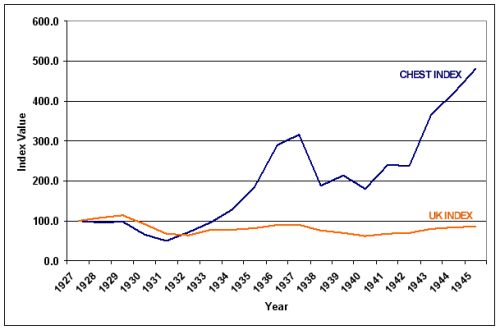
The performance of Keynes’s fund from 1927 to 1946 is shown below.
During these years the Chest grew at an annual compounding rate of
9.1 per cent while the general British stock market fell at an
annual compounding rate of slightly under 1 per cent.


Maynard Keynes Chest Fund


R.F. Harrod – The Life Of John Maynard Keynes, 1951

William T. Ziemba – Hedge Fund Strategies, Performance, Risk and Disasters and their Prevention, 2004

Mark Harrison – The Empowered Investor, 2002

John Maynard Keynes – The General Theory of Employment, Interest and Money, 1936

Robert G. Hagstrom – The Essential Buffett; 

Timeless Principles For The New Economy

Robert Skidelsky – John Maynard Keynes 1883 – 1946, 2003

Warren Buffett – Letter To the Shareholders of Berkshire Hathaway Inc., 1991

Monday, July 13, 2020

Disney's Real Magic


All copyrights  and content belong to the publisher and Lenore Briloff
________________________________________
By  Abraham J. Briloff
March 23, 1998 12:01 am ET


Disney's December 1997 Quarter

The Walt Disney Co.'s acquisition of Capital Cities/ABC, by Wall Street's lights, has been a resounding success. Any misgivings about the movie and theme-park giant shelling out $18.9 billion for control of the television network have been dispelled by Disney's ability to continue reporting brisk earnings gains, and investors have responded enthusiastically. Disney's shares, which closed at 58 on July 31, 1995, the day the companies' betrothal was announced, not long ago topped 115. Even Disney's public disclaimer, a couple of weeks ago, of the Street's more exuberant expectations for its earnings had only a slight dampening effect. The shares closed Friday at 107.

A spate of ho-hum movie releases during the second fiscal quarter (ending March) was the official explanation for the caution. Analysts dutifully trimmed a nickel or so a share from their forecasts, bringing the consensus to $3.17 for fiscal 1998, ending September. That still represents a healthy rise from last fiscal year's $2.75, and the stock is trading at better than 35 times earnings. In truth, however, the gains in Disney's reported results over the past five quarters have been significantly enhanced by creative accounting. Indeed, the fact that Disney has now virtually exhausted the source of this stimulus largely explains the anticipated earnings disappointment.

The accounting treatment accorded the merger by Disney, and signed off on by its certified public accountants, Price Waterhouse, allowed the entertainment company to create what amounts to an undisclosed reserve of as much as $2.5 billion to absorb costs and expenses incurred subsequent to the February 9, 1996, close of the merger -- costs that otherwise would have flowed through its income statement and reduced Disney's reported earnings.

In fiscal 1997, the device permitted Disney to show a glitzy 25% earnings gain instead of what would have been a not-quite-10% gain. In its most recent quarter, ended December, the company's merger accounting exertions transformed what otherwise would have been essentially flat earnings into a double-digit increase.

In a letter to this author dated Friday, John J. Garand, Disney's senior vice president for planning and control, strenuously defends the company's accounting treatment of the merger as "appropriate" and says it was mandated by generally accepted accounting principles (or GAAP).

Indeed, when Disney took over Cap Cities/ABC, it did so -- in strict accordance with GAAP for business combinations -- as a "purchase." Which meant that the $18.9 billion Disney paid for the television network ($10.1 billion of it in cash, the remainder in 155 million Disney shares) was accounted for by first allocating the cost to Cap Cities/ABC's identifiable assets and liabilities, based on estimates of the fair value of those tangibles. Then, whatever remained of the purchase price was allocated to the intangible asset known as goodwill.

According to Disney's accountants, goodwill was virtually the only thing Disney got for its $18.9 billion. A footnote in Disney's annual report for the fiscal year ended September 1996 shows that the fair value of the Cap Cities/ABC assets it acquired, at $4.8 billion, was nearly matched by the value of the liabilities it assumed, $4.4 billion -- leaving precious little, obviously, in the way of net tangible assets. In fact, an additional $749 million ABC liability, for deferred income taxes, was booked in the March 1997 quarter, reducing the total value of the net tangible assets that Disney acquired in the Cap Cities/ABC transaction to less than zero.

As a result, more than the $18.9 billion purchase price was ultimately dumped into goodwill. Paying $19 billion for goodwill is essentially equivalent to forking over $30 billion for, say, TV and film properties, because the cost of goodwill is not tax-deductible (in contrast to normal business expenditures), making the after-tax impact of a deductible $30 billion expenditure roughly equal to a $19 billion nondeductible outlay.

Striking, too, is the dramatic divergence between Disney's assessment of the fair value of Cap Cities/ABC's net tangible assets and the balance sheet developed for the network by Ernst & Young, its independent certified public accountants, as of December 31, 1995 -- just 40 days prior to the closing of the merger. Indeed, Disney put Cap Cities/ABC's shareholder equity on the financial equivalent of a miracle diet, making the TV network's $4.5 billion of pre-acquisition shareholders' equity essentially disappear in the translation onto Disney's books.

What happened to those billions? Let's take Cap Cities/ABC's assets first. A $2.8 billion reduction, to $4.8 billion from $7.6 billion, was attributable principally to the elimination -- routine in these circumstances -- of goodwill that had been carried on the network's books. Thus, that $2.1 billion intangible asset presumably was subsumed into the $19 billion of goodwill added to Disney's balance sheet by the transaction.

The remaining $700 million reduction in Cap Cities/ABC's assets represents downward adjustments to the carrying values of its film properties as well as to property, plant and equipment. While a haircut of that size might ordinarily attract critical scrutiny, there are far more daunting issues involved here.

Not least among them is the $1.7 billion increase, to $4.4 billion from $2.7 billion, in the network's liabilities. In fact, it is the key to unraveling the unorthodox purchase-accounting maneuvers that provided Disney with its reserve of as much as $2.5 billion to absorb post-merger costs.

Disney's $700 million writedown of ABC's tangible assets and $2.9 billion increase in its liabilities, at the time of the merger, were merely book entries, and didn't entitle it to a current tax deduction. But as that $3.6 billion ripens into tax-deductible business expenses, the company will derive a $1.2 billion tax benefit. This contemplated entitlement is dubbed a "deferred tax asset" and is netted against Disney's deferred tax liabilities -- and thereby reduces the $2.9 billion gross increase in liabilities to $1.7 billion.

The $2.9 billion of additional liabilities was poured into the "accounts payable and accrued liabilities line" on Disney's balance sheet in connection with the merger and represents loss reserves and other liabilities added in the name of purchase accounting.

John Giesecke who, until leaving last month was Disney's vice president for corporate controllership -- was consulted a number of times, by phone and fax, during the preparation of this analysis. When he was asked whether the entire $2.9 billion addition to Disney's liabilities represented the reserve booked on the Cap Cities/ABC takeover, he indicated that the $2.9 billion figure was on the high side for the "loss reserve." Some of the accruals, he pointed out, were related to the fact that Cap Cities/ABC's package of perquisites had to be sweetened to bring them up to Disney standards.

Giesecke would not commit himself on the actual size of the loss reserve. However, even taking more generous benefits into account, it's a reasonable estimate that these Disney merger-accounting exertions produced a decidedly unmousesized pile of $2.5 billion of accrued liabilities out of which the company could pay post-merger expenses without impacting its bottom line.

Giesecke did not respond to faxes of January 7, February 3 and March 19, which attempted to apprise him of the gist of this analysis and the numbers critical to it. Disney's Garand, as noted, did respond late Friday. His letter took issue with the use of the term "loss reserve" to describe the $2.5 billion of liabilities created by the company's purchase-accounting -- stressing Disney's belief that it followed GAAP -- but he did not dispute the size of the reserve.

How did Disney's accountants justify the creation of that huge reserve -- justify adding some $2.5 billion in liabilities to its balance sheet? Especially liabilities that, 40 days before, hadn't existed on Cap Cities/ABC's balance sheet? Basically, by asserting that Cap Cities/ABC's accountants had ignored the impact of timing on anticipated cash flows from future programming that the network had agreed, at least in part, to finance.

As Disney's Giesecke explained, under the historical cost-accounting rules the network followed before the merger, Cap Cities/ABC wasn't required to record a liability for losses on programming that it was committed to acquire in the future, as long as anticipated revenues were expected to recover the network's cost. After the merger, however, the controller maintains that Disney was required, under the dictates of purchase accounting, to evaluate those same commitments on a fair-value basis. In other words, Disney had to discount the expected future revenues and costs related to the network's programming commitments at an appropriate rate.

Disney engaged Price Waterhouse to carry out those evaluations, Giesecke said, and when the work was completed, "We determined that the fair value of a certain number of these commitments was negative and we recorded a corresponding liability."

"Commitments" is a generic term; all undertakings are commitments. Most are so ordinary, ongoing and of relatively modest proportions that no special attention is given to them by accountants. Where, however, they are long-term and substantial some notice may be given to them, generally in the footnotes to the financial statements. For example, long-term leases, or -- in the case of Cap Cities/ABC -- commitments to purchase future programming. Still, they're only claims that may occur if a contract is performed upon, in the future. The mere signing of a contract doesn't result in a completed transaction -- much less a liability.

That's because "liabilities," in accounting parlance, are recognized obligations to pay money, provide services or transfer specific assets, and are tallied as such in the accounting cycle. They must be fully disclosed in financial statements and are subtracted from a firm's assets to derive its shareholders' equity.

Cap Cities/ABC programming commitments totaled $4.1 billion at year-end 1995. The network's final audited financials (submitted to the SEC in a Disney 8K report dated March '96) disclosed that these consisted of contracts to purchase "broadcast rights for various feature films, sports and other programming" during the next five years. There was nary a hint in ABC's financials, however, of anxiety on the part of ABC management or its auditors regarding the economics of those programs or projects. To the contrary, all were deemed to have been undertaken in the normal course of ABC's business -- there was nothing contingent about them.

Indeed, the plain truth that Disney ignored in applying a discounting factor to future revenues anticipated on programming Cap Cities/ABC was committed to purchase (and in thereby creating those $2.5 billion of "liabilities") was that there was nothing novel about those contracts. Over its half-century of existence, the network's ordinary operating cycle had always encompassed both commitments to purchase future programming and current income representing the "ripening," or coming to fruition, of past programming outlays. In short, the network's programming commitments were simply a consequence of the ordinary operating cycle of a going concern.

In fact, in this author's view, Disney's booking of those $2.5 billion or so of additional liabilities related to the network's future programming commitments as part of accounting for the merger as a purchase was simply not permissible under GAAP. Only liabilities which are identifiable as such for the acquired enterprise, or contingencies that may have "ripened" into liabilities as of the acquisition date, should properly have been booked as liabilities by Disney.

This interpretation of the accounting rules is fully supported by an October 13, 1997, letter from the Financial Accounting Standards Board, which (in part) reasserted the board's long-held position that the same rules should apply to "recognition and measurement provisions arising from a business combination" and to "those incurred in the normal course of business." FASB's position is unambiguous: If, pursuant to its Statement 5 (which deals with contingencies), no such undiscounted/discounted liability reserve is permitted, one cannot be created in the process of accounting for a merger.

And there's no way Disney's $2.5 billion reserve for the discounted value of the network's programming commitments would qualify as a liability under FASB Statement 5. That litmus test is whether "a liability had been incurred at the date of the financial statements." If that test could have been met as of December 31, 1995, Cap Cities/ABC's accountants would have been constrained to reflect a $2.5 billion liability in the network's final financial statement. But there was no such liability then -- neither did one come into existence during the succeeding 40 days while the merger was being closed.

Disney and its auditors clearly interpreted GAAP far more aggressively in transmuting some of those $4.1 billion of commitments, per ABC's final annual report, into a $2.5 billion undisclosed liabilities reserve. Under the circumstances, investors might reasonably have expected, at the very least, a clear explanation of the purchase-accounting adjustments to Cap Cities/ABC's programming commitments in Disney's financial statements. Yet none is to be found.

Yet the reason Disney went out on a limb to create its undisclosed reserve is clear enough: flexibility. It meant that as its new television arm ran up various programming costs after the merger, Disney had the option of merely writing those amounts off against those accrued liabilities instead of running them through its income statement -- where they would have crimped reported profits.

In the immediate aftermath of the February '96 merger, and, in fact, all the way through the quarter ended December 1996, Disney had no call to draw on its big reserve. The comparative year-earlier figures included in its financial reports throughout that stretch incorporated the operations of Cap Cities/ABC on an entirely pro forma basis. Midway through its March 1997 quarter, which marked the first anniversary of the acquisition, that changed: Disney was now going head-to-head with real numbers generated by the network while within its ambit -- and those were less than ebullient.

A couple of unheralded adjustments that Disney made to its books for that quarter first signaled that Disney was dipping into its $2.5 billion reserve to cushion earnings. Without a whit of explanation, the March '97 balance sheet showed a fiscal '96 year-end value for the asset dubbed "TV and Film Costs" that had been retroactively decreased by $653 million from the amounts listed in Disney's fiscal '96 annual report -- and a corresponding decrease on the liabilities side of the ledger.

When queried, Disney's Giesecke indicated that the balance sheet was adjusted because a previously recorded valuation allowance for film and TV costs had been reclassified. He also commented that the reclassification had "no income-statement impact." In his Friday letter, Disney's Garand reiterated that the balance-sheet reclassification, a final purchase-accounting adjustment related to the merger, affected only Disney's balance sheet.

Which is true, in the sense that the reclassification didn't involve any changes to the income statement for fiscal '96. But they laid the groundwork for enhancing earnings in the future. The $653 million represented production costs the Disney broadcasting unit had run up during fiscal 1996, costs Disney initially had treated conventionally: They'd been added to the "TV and Film Cost Assets" line on Disney's balance sheet, and fiscal '96 operating net had been reduced by some $200 million in amortization of that asset.

What Disney in March '97 determined, however, was that those $653 million of costs should have been written off against its $2.5 billion reserve. That way, its operating income in future periods wouldn't be burdened with the amortization of the network costs. Hence, its retrospective balance-sheet adjustments.

What Disney didn't do, though, was restate its already-reported fiscal '96 earnings to reflect the benefit of the lower amortization charges produced by this accounting device.
Disney's Garand insists in his letter that "it would be inappropriate to consider restating" the company's fiscal 1996 income because the retrospective changes it made affected only its balance sheet on the one hand, and, on the other, were merely offsetting adjustments to a couple of lines in its statement of cash flows. However, in fact, the company's reported fiscal 1996 income had been reduced by amortization of those $653 million of costs that Disney subsequently reclassified. And a logical inference is that the company's earnings weren't restated because the object of these accounting exertions was to enhance future earnings comparisons.

Another retrospective change Disney made to its financial statements for the year ended September '96 provides a clue to quantifying how much the company used the reserve to absorb costs in succeeding periods. Specifically, Disney's fiscal '97 10K listed a decline in the deferred-tax asset, as of September 30, '96, of $241 million from the total it had reported a year earlier. Which was how much Disney was able to reduce its deferred taxes by retrospectively charging the $653 million of costs against its reserve.

In fiscal '97, Disney's deferred-tax asset was further reduced by $493 million, to $1.129 billion. Assuming, again, a 35% corporate tax rate, that implies that during that year, about $1.4 billion, previously stashed away in Disney's accrued liabilities reserve, was spent -- without impacting the company's operating statement. Outlays of $1.4 billion would entitle the company to apply $493 million of the related tax asset to reduce its current tax provision.

Disney's Garand, in his Friday letter, insists that this $1.4 billion estimate is incorrect; that the amount of costs absorbed can't be calculated based on the change in the company's deferred-tax asset, which "resulted primarily from unrelated factors."

Nonetheless, its most recent quarterly report indicates that the company ran through virtually all of the remaining $450 million or so in its liabilities reserve during the quarter. Which strongly suggests that the reserve absorbed around $1.4 billion of costs during fiscal 1997. And, to reiterate, that's what likely prompted Disney's caution to analysts to rein in their full-year earnings estimates.

Indeed, Disney pretty much admits that it has used up its purchase accounting benefits in the "Management's Discussion & Analysis" section of its recent 10Q, noting that an 11% increase in its broadcasting unit's costs and expenses "reflected higher program amortization at the TV network , due primarily to changes in the program mix in response to lower ratings and a reduction in benefits arising from the ABC acquisition ." (Emphasis added.)

How much did Disney's treatment of those TV production costs, totaling $653 million, $1.4 billion and $450 million, respectively, boost its bottom line during fiscal '96, '97 and the first quarter of '98?
According to Disney's 1997 statement of cash flows, it had charged $204 million of amortization against those $653 million of TV & Film Cost Assets during the 7 1/2 months of fiscal '96 that the network had been in its fold. Which means that a full year's amortization of those assets would have amounted to roughly $320 million, or about $80 million a quarter.

The accompanying tables use the same amortization rate to quantify the amortization charges Disney avoided in fiscal '97 and in the December quarter by writing off that total of $2.5 billion of television production costs against its undisclosed reserve. They also give Disney the benefit of some accounting charges it would have avoided had it not employed that accounting device, most notably a reduction in its amortization of goodwill. While, by necessity, they're only estimates based on the publicly available data, the calculations demonstrate that by calling on the reserve, Disney supercharged its recent earnings comparisons. More specifically, it avoided some $840 million in charges against its fiscal '97 operating income, and around $290 million of such costs in the December quarter.

Clearly, had Disney not been able to use its reserve to shield its bottom line from major chunks of costs related to its foray into television network ownership, its recent results would have had considerably less luster. Indeed, the 25% earnings surge Disney reported in fiscal '97 would have come to 10%, without benefit of the accounting device. And, far from an 18% earnings increase in the December quarter, net would have been flat.

Disney, through the agency of accounting, has adeptly masked the negative impact of its Cap Cities/ABC acquisition on its earnings over the past two years. But even accounting magic has its limits: From here on, the true picture will become very much clearer.

ABRAHAM J. BRILOFF, a CPA and a frequent contributor to Barron's over the past 30 years, is the Emanuel Saxe Distinguished Professor Emeritus at Bernard M. Baruch College and Presidential Professor of Ethics and Accounting at Binghamton University, SUNY.

Li Lu - Carrie Cunningham

Tiananmen Square to Wall Street: Li Lu Hits the New York Jackpot

Li Lu, a student leader in the Tiananmen Square uprising, has jumped headlong into the bull market. In January, he rented two rooms of office space on the 15th floor of 660 Madison Avenue, and, equipped with a phone, a computer and a Bloomberg machine, he got to work investing other people’s money, running a high-risk hedge fund called Himalaya Capital Partners L.P. The minimum investment is $1 million.
In setting up the fund, Mr. Li said he’s experiencing firsthand the capitalism and democracy he was fighting for in his homeland. “Free man, free market,” is a phrase he invokes often.
Mr. Li is 32 years old. He wears Armani suits that he buys at a factory outlet; he lives in one of those bland modern towers on the East Side. While other Wall Street hotshots his age may have endured the trauma of not getting into the business schools or investment banks of their choice, Mr. Li has survived poverty, separation from his family (his parents were forced into labor camps) and a devastating earthquake. When he escaped to America after hundreds of his fellow protestors were killed in Beijing, he was one of the most wanted dissidents in China.
His clients hope they’ll see big profits, but they also seem to be investing in the future of Mr. Li himself. Jerome Kohlberg Jr., a founder of the leverage buyout monolith Kohlberg, Kravis, Roberts & Company, said his decision to invest with Mr. Li “wasn’t my usual cautionary thing, but my admiration prevailed … I don’t know about others, but I would like to see him succeed and eventually help bring China into the 21st century and be a democracy, and I think he, by then, will be uniquely qualified.”
Others who have invested in Mr. Li’s new hedge fund include: Stanley Shuman, executive vice president at Rupert Murdoch’s deal maker, Allen & Company; Jack Nash, co-founder of Odyssey Partners L.P.; Robert Shaye, chief executive of New Line Cinema Corporation; Robert Bernstein, former chief executive of Random House Inc. and a founding chairman of Human Rights Watch; and his son, Tom Bernstein, president of Chelsea Piers Management Inc. And proving that it’s a chic investment, there is also Sting, the sensitive rock star and rain forest activist, who has kicked in with at least a million of his own.
The glittering client roster seems not to intimidate Mr. Li. “You prove to them you’re good, people trust you,” he said over iced tea at Sofia’s Fabulous Grill on the Upper East Side. “They don’t ask how many years I’ve managed a fund. The question is, Can you make me money? Show me the money! This is one area where, if you really believe you’re smart and you’re unique and you’re different, this can be challenging-this is it. Because if you’re right, you make a lot. If you’re wrong, you lose a bundle.”
With the Dow Jones average rising above 9,000, the latest financial district jokes and clichés liken good investing to good sex. Mr. Li considered the comparison. “This market is not a man’s sex drive,” he said. “If you had to compare it, this market is a woman’s sex drive. It is really experiencing a multiple climax, but even the woman has downtime. The traditional Chinese sentiment is that the woman has the capacity to climax 15 times. The market is turning into the traditional description of the woman’s sex drive. My girlfriend is around that number.”
So how long can it last? “Nothing goes forever,” Mr. Li said. “As I say, even if you compare it with the woman’s sexual capability, it has an end. This market is capable of multiple climaxes, but there is a recession.”
Born in 1966, the year Mao Zedong initiated the Cultural Revolution, Mr. Li was separated from his parents when he was less than a year old. He passed through half a dozen adoptive families during the first decade of his life. Mao’s regime condemned his mother, a botanist and the daughter of a wealthy landowner, and his father, an engineer, as bourgeois intellectuals-and therefore enemies of the state. They were sent to separate labor re-engineering camps. Facing a life of hard labor, Mr. Li’s mother was forced into having to choose one of her children to keep with her. She kept Mr. Li’s older brother.
“Mao Zedong’s way was to make people crazy,” Mr. Li said. “It was like a religious cult. You cut all the culture, you kill or jail all the people with learned minds who think independently. Anything that remotely reminded you of humanity was destroyed.”
On the eve of Mao Zedong’s death in 1976, Mr. Li survived an earthquake in Tangshan, China, that killed the adoptive family whom he had grown to love. In the earthquake’s rubble, the 10-year-old boy ran through the city; the dead bodies overwhelmed him and he blacked out. When he came to, he saw a woman giving birth and heard her cries.
Days after the earthquake, radio propaganda claimed that Mao Zedong’s administration was helping his ravaged town-something that ran counter to what he saw. “The soldiers and party officials are grabbing all the things available for relief for themselves or their family,” he recalled. “Older people just don’t get anything. So I developed a tremendous aversion, you know, hatred toward those people.”
He was living with his blood family again and came under the guidance of his grandmother, a founder of elementary schools in the 1930’s. She told him the only way he could beat the government and help people was, first of all, to educate himself. Mr. Li immersed himself in books, which gave him the idea that “other people have lived a different life, a better life, so should I-so should everybody.”
His convictions led him to Nanjing University and Tiananmen Square. He was deputy commander of the student movement, second to Chai Ling, who is now at Harvard Business School. He saw many of his fellow student protesters shattered by the massacres. “They couldn’t get over this sense of loss and failure and guilt,” he said. “It was terrible and I had some of it.”
He arrived in Manhattan in December 1989. By 1996, he had earned a B.A., M.B.A. and J.D. from Columbia University, and written a memoir of his experiences in China ( Moving the Mountain , Macmillan London). With royalties from the book, as well as fees earned from giving lectures, he made investments and rode the bull market to the $125,000 he needed to pay his living costs and the tuition not covered by his scholarship.
“Early on,” he said, “I know I gotta make money work. The whole thing is, really, money makes money. That’s the whole thing about capitalism. Without the capital, there is no -ism.”
His early success in investing, linked with his abysmal experience with communism, made him a true believer in the free market. “But the precondition of capitalism is a free man,” he said. “With free market and free man, if you remove one of them, it is not called capitalism in my dictionary. Without a free man, there is no free market. That’s called exploitation. In China, there’s not capitalism. It’s official corruption, that’s what it is.”
Before striking out on his own, Mr. Li worked for a summer at the white-shoe law firm Simpson, Thacher & Bartlett, put in four months at the media investment-banking firm Allen & Company and spent two years as a corporate finance associate at another investment banking firm, Donaldson, Lufkin & Jenrette. The chores that go with pleasing clients didn’t sit well with him. “It’s very hard for me in the service business,” he said. “I want to make up a decision and do it. I’m a doer rather than just giving ideas.”
Mr. Li’s liberation from corporate hell came on the red-eye from San Francisco to New York last year. On the flight, he saw Rena Shulsky, a Manhattan real estate magnate whom he had met while giving a lecture. She encouraged him to start a fund. “I thought he could do better than working at D.L.J.,” she said. She also, according to Mr. Li, gave him something better than advice-namely, $2 million in seed money. (Ms. Shulsky would not comment on how much she invested with him.)
Tom Bernstein, who helped Mr. Li gain asylum in the United States in his role as board president of the Lawyers Committee for Human Rights, was another early investor. “We kid about Li Lu,” Mr. Bernstein said. “If you said that someone was going to make a billion dollars and be the head of the largest country in the world, all in one lifetime, he could be the guy.”
Two investors said John Kluge, chairman of Metromedia Company, had invested in Mr. Li’s fund this past January. Which seemed odd, given Mr. Kluge’s recent meeting with Chinese President Jiang Zemin concerning the possibility of expanding his company into China. (Mr. Li at first would not comment on Mr. Kluge; in a later interview, he said Mr. Kluge was not one of his clients. Mr. Kluge did not return calls seeking comment on the matter.)
Mr. Li said he likes to buy stocks that are undervalued, in his estimation. That goes against the currently fashionable “momentum” theory used by investors who believe they can ride an overvalued stock that is still soaring in price, and then jump out before the stock comes crashing back down.
“If you’re right, ultimately it will prove you’re right, but you look stupid for a long time,” he said of his own gambits. “It is what I’m all about. It’s revolutionary. It is about trusting yourself. It’s about challenging the conventional wisdom. That’s what we did in Tiananmen.”

Li Lu - National Museum of American History


Li Lu, founder and chairman, Himalaya Capital Managementexcerpted from an interview with the National Museum of American History, May 3, 2016. Edited for clarity by the National Museum of American History, November 2016.
I was born April 1966 in China at the dawn of the Cultural Revolution which is probably the darkest moment in modern Chinese history. My parents and my grandparents were imprisoned or sent into labor camps merely for being intellectuals, and I spent most of my childhood rotating between foster families. I didn’t have much intimate connection with my biological family. I'm a survivor. I tried to identify with any family that took me in and learned to fit into whatever environment I found myself. I lost my then adopted family in 1976 from a devastating earthquake in my home town that killed 240,000 people and wounded much of the rest, the worst earthquake in recorded history. That was also the year when the Cultural Revolution ended, so my biological parents were freed, and I was reunited with them.
Growing up, I had wonderful teachers. I also learned from my own grandmother who was one of China's first women educators. She was the principal of the best primary school in her province, and she was among the first to take young girls into modern education. She was also persecuted for many years during Mao’s era but survived. In many regards, she was my hero. I started university in China in 1985 at Nanjing University studying physics. It was really the best physics department in the country, and I stayed there for nearly four years.
My generation was quite unique. We grew up during the Cultural Revolution, and then as we came of age, we experienced Deng Xiaoping’s “open door” policy. For the first time since 1949, China opened its doors to the rest of the world. We began to see a whole different world, so it was an era of great hope and idealism.
The students became very active in pursuing reform. In 1989, a series of different events transpired together, later known as the Tiananmen student protest, and I was fortunate to play one of the leading roles in that movement. 
There were 300 or 400 different cities involved in the demonstration to varying degrees, and there was a general hope that things could change for the better, and it is everybody's responsibility to do something about the future of our country.
On June 4, 1989, the Chinese government ordered the army to open fire on the students and citizens. It was known as the June Fourth Massacre, and the government put a number of the students and intellectuals on the most-wanted list. I was one of those people, and so my picture began to appear on television and all over the streets. It was almost impossible to stay there.
I moved into hiding, and there were a lot of courageous people who really took it upon themselves to rescue us. It was through that underground railroad that I escaped through the South China Sea to Hong Kong, and from there to France, and from France eventually made my way to New York City at the age of 23.
I went to New York because my grandfather had studied at Columbia and got a Ph.D. At first, I enrolled in the American Language Program at Columbia to learn English. Over the summer, I studied from eight o'clock in the morning to eight o'clock at night in a very intensive program to learn English. In the fall, Columbia put me into the School of General Studies. At the time, I had studied for about three and a half years in China, but I could not get any transcripts. There was no proof that I had actually studied. So I had to do things all over again.
I got a scholarship, and then in the second semester I was transferred to Columbia College. A year and a half later, I was told that there was a joint program between the college and the law school, so I applied for it and got in. A year later, I heard there was a joint program between the law school and business school. I applied and I got in. I ended up joining all three schools—college, law school, and business school—over a six-year period. When I graduated, I was probably the first one in the history of the University who graduated with three degrees simultaneously. I don't think it would have been possible anywhere else. America is really quite unique in that regard. 
One of the classes I took involved reading the great classics that helped to shape Western civilization. The idea is that all those great classics contain our original ideas that continue to shape the way we think today. That really helped me understand America and contemporary Western society. I no longer felt alien to the culture.
We also had a class called the extended core, which examined, in the same way, the great classics in the form of the Confucian tradition as well as the Islamic tradition. I also found a great deal of kinship with the intellectual ideas and ideals of the culture that I came from. I began to see the two cultural traditions live in peace with each other inside myself. In my forties I came to an epiphany that I am both 100 percent Chinese and 100 percent American.
I now feel that one plus one equals eleven, and that's what really makes America powerful, and as long as this country continues to have the ability to attract people from different cultures it will be wonderful.
When I was a student at Columbia, I was very poor and I looked at all the bills and all the debt, and I wondered how I was ever going to be able to pay it back. I asked my friends how to make money. One day, they handed me a flyer and told me, “If you really want to learn how to make money, you have to go to this event.” I took the flyer, and it said there would be a lecture with a buffet. So I thought, at the worst, I’d get a free lunch. I went and there was no buffet; it was this guy named Buffett.
Warren Buffett opened my mind, and over the following year I tried to find out everything about him and read everything he wrote. A year later, I bought my first stock, and I continued as an amateur investor throughout my Columbia days. By the time I got out of school, I was looking at my balance sheet and realized, I didn’t have to work for anybody, I can just do this, and so I became self-employed.
About six to seven years into my career as an investment manager, I was introduced to Mr. Charles Munger by a mutual friend. Charlie Munger has been Buffett’s partner for more than fifty years. We talked for five or six hours, and at the end of the conversation, Charlie mentioned casually that under certain circumstances he might become an investor in my fund.
A few months later, he became my largest investor, and the rest is history. He lived in Los Angeles, and he urged me to come to California, so that's why I moved here. I don't think that leading businessmen of any other country would trust their money with immigrants from a different country. Your ability, your energy, your integrity, and nothing else—that is uniquely American. That's what makes America so successful in terms of business; everybody has an equal opportunity.
I've been blessed and extremely lucky. Halfway along the way, I figured this is too easy; we've got to do something harder. So instead of making money by buying and holding securities, we decided we should probably start businessesI started a venture capital business, and we funded a dozen or so different companies from the ground up. Half of them failed right away, but the other half turned out to be very successful.
I take pride in the fact that I've traveled a long way. I couldn't make it by myself. You've got to cross a lot of bridges, cover a lot of roads, to get here. The people I met throughout my life, those people are my bridges, my roads. I certainly did not take myself along without their help. The only thing I did was simply take the journey.  Each step of the way you have to constantly improve yourself, constantly learn new things, and that's really what makes life fascinating to me.
An unedited transcript of this oral history is available for scholarly research through the Archives Center of the National Museum of American History.