November 5, 2019 Koito Manufacturing (TSE:7276)
Brief
Summary:
Market Cap ¥962-986B (USD9B)
Net sales ¥832B (USD7.6B)
Total Debt ¥29.6B (USD271M)
Cash ¥277.7B (USD2.5B)
Enterprise Value 986 + 29.6
– 277.7 = ¥737.9B (USD6.75B)
EBIT = ¥96.7B (USD885M)
FCF = ¥37B (USD338M)
Earnings power = ¥65-70B
(USD640M)
Tangible Book Value = ¥507B (USD4.6B)
Working Capital = Current
Assets – Current Liabilities = 503 – 186 = ¥317B (USD2.9B)
Working Capital – Cash = ¥39.3B
(USD 400M)
Net Property Plant &
Equipment = Fixed Assets = ¥169B (USD 1.5B)
Capital Employed =
Debt + pensions + Fixed
Assets + Working Capital -cash - goodwill - intangibles
= 235B yen (USD2.15B)
Capital Returned (Owner’s
earnings) = ¥70B (USD640M)
ROIC = 12%
(ROIC for previous 4 years =
11-14%
Quick Summary:
Koito
(TSE: 72726) is a Japanese automobile lighting OEM selling, as of November
2019, for 9x earnings, and only 7-8x earnings net of cash with a debt to equity
of 7% and a quick ratio of 2.1x. Operating margins are 10%.
The
company is a leader in automobile lighting and once captured 20-25% of the
global auto-lighting market and was a target of T.Boone Pickens for a hostile
acquisition back in the 1990’s which led Koito to change to a more protective
ownership structure. Koito consists of 32 companies located in 12 countries
worldwide, employs approximately 25,000 employees, and achieves annual sales of
approximately USD 7 billion.
Koito
has close ties with Toyota; Toyota owns 20% of Koito’s issued shares and makes
up 21% of their orders and sales. Despite progress in North America and Asia,
Koito’s global market share dropped from 18% to 13% when they got into a
dispute with their Chinese partner Huayu, in which they had a JV in a company
called Shanghai Koito. Huayu previously offered sales distribution, and the
loss of a trading partner temporarily hit Koito’s sales in China.
Newer
car models are switching from halogen bulbs to using Xenon Bulbs (gas filled) and
now LEDs (light-emitting-diodes), which are more energy efficient. While LED’s
average sale price may eventually drop, each set currently commands a 20-60%
premium to halogen bulbs. When xenon bulbs were first released, its cost was
2-3 times more to produce than halogen bulbs.
While
the automobile landscape is being changed by electric vehicles and autonomous
driving, technological change will not render automobile lighting obsolete in
the next decade. I also do not foresee a displacement of the current players by
incumbents. Regulatory environment and significant funding for facilities
create barriers to entry. Favorable new developments in Brazil, Asia, USA, and
China makes Koito’s share price undervalued.
Automobile Lighting
Market Background:
A single car has about 30,000 parts, if you include parts
down to the smallest screws. Many car models are released each year, and in
terms of lighting for automobiles only, each model has a front lamp, rear lamp,
signal lamp, fog lamp, interior lighting etc. Each lighting OEM bids for
different sections for one vehicle model. For example, for the latest Toyota
Camry, Koito may win the head lamp and signal lamps, while Japanese competitor
Stanley Electric (TSE:6923) may win the rear lamp and interiors for a
particular model. OEMs engage in a bidding process where quotations are
submitted.
In the automobile supply chain, Koito is a Tier 1 supplier—
they only supply parts directly to manufacturers and are tightly coupled with a
few car brands and are at an arms-length relationship with others. Tier 2
suppliers do not supply directly to brands and may produce parts for
non-automotive customers, while Tier 3 produces raw materials like metals or
plastics.
Once automobile companies decide on successful bidder, there
is a finalization on drawings and specifications. Koito and Stanley Electric
was in trouble recently in an anti-trust litigation in Michigan for fixing
prices and rigging bids in North America through their connections with
Japanese automobile brands— Honda, Toyota, Nissan, Mitsubishi, Isuzu, etc.
Japanese car brands prefer maintaining a relationship rather
than obtaining the lowest price on a tender— Japanese lamp OEMs have a small
amount of shares of their Japanese customers and vice versa, and bids are
“favored” towards particular OEMs, rewarding them with consistent demand. Corporate
raider T. Boone Pickens was rattled about Toyota previously squeezing margins
out of Koito as their favored supplier. While Koito is still Toyota’s preferred
lighting supplier, Koito has a more diversified customer base now, including–
Audi, GM, Geely, SAIC, thus Koito is not at the mercy of losing a particular customer.
This is reflected in operating earnings of 10-15% today, when was only 5% a
decade ago.
The automobile lighting market will grow from 30B in 2019 to
35-40B in the next five years. Of this 30B, 66% is predominantly passenger
cars; 33% are vans, trucks, and larger vehicles. It makes sense to focus on the
Asia Pacific region, as the compounded annual growth is 5-6%, while the U.S is
2-3.5% and China is also slowing down due to the trade war.


Competitors
To contrast this, in 2014, total operating profit was half of 2019, at 49B yen. Japan made up 60% EBIT at 30.3B yen, North America and Mexico had 3% of EBIT at 1.5B yen, China was 19% at 9.5B yen, and Asia was at 13% at 6.4B yen.
Situation in China:
China has the largest vehicle production in the world with a capacity for 35 million units, but only had a sales volume of 25-27 million units or less due to the termination of a tax exemption for small vehicles and the US-China trade-war.
There are 5 dominant OEMs in the automobile lighting business:
1. Koito-Manufacturing;
2.
Japanese
competitor Stanley Electric which has close ties with Mazda;
3.
French
company Valeo, which acquired Japanese company Ichikoh, and dominates the
European market;
4.
German
company Hella, which initially cooperated with Koito to enter the American
market and now in Mexico;
5. German
company Osram which licenses their technology to both Koito and Stanley Electric.
Auto-lamp OEMs should be conservative in building facilities
abroad and growth of fixed assets. In a recession, should there be less demand,
unit volume produced may not come close to capacity— a low utilization rate
results in losses and negative operating margins. It also helps to have ample
working capital and even excess cash. Koito passes all of these tests.
French company Valeo has the largest market share in Europe
and has acquired struggling Japanese company Ichikoh. The synergy has proven to
be less than desirable, as utilization rates and penetration into Asian markets
are poor. Each year, Valeo’s revenues from Europe alone amount to USD 10.6 billion,
while their total sales is the largest among peers at USD20B. In terms market
share, Valeo is the largest auto-lighting company with USD9.3B market cap. Valeo
is over-leveraged with debt to equity significantly higher than peers at 139%.
Valeo delays payment to suppliers— their days-payable is 109 days, when the
industry norm is 40-50 days.
Koito was wise not to build factories over aggressively in Europe
to gain market share. Czech Republic and U.K are Koito’s only centers. Europe
has been dominated by Valeo, with Hella licking the remaining scraps in Germany.
Each additional unit sold in Germany may require additional marketing, passing
of bureaucratic regulatory requirements, and might not create additional
shareholder value.
German company Hella previously collaborated with Koito to
enter the American market and still work together for new factories in Mexico. As
of November 14, 2019, Hella’s enterprise value USD 5.89B, and operating
earnings of approximately USD 500 million, bringing its multiple close to 12x,
similar to Valeo’s. However, Hella is more conservatively financed with a debt
to equity of 50% and cash of USD1.6B. Return on capital is 7%.
Osram has negative earnings due to weak growth in China and
problems in their supply chain. They are not a pure player in automobile
lighting; segments include— digital products, photonics, opto-semiconductors. Osram licenses a lot of their proprietary technology
such as white LEDs, and adaptive beam lighting. Toyota Corolla uses Koito Signal Lamps which employ XLS LED Signal
Emitters from Osram.
Japanese listed Stanley Electric’s large customer is Mazda making
up 12% of their sales and has a 33% ownership in a listed company called Thai
Stanley Electric which has a domestic (Thai) monopoly on motorcycle lamps.
Stanley Electric boosts higher gross margins than Koito, but SG&A margins
are double of Koito at 10%, and ROIC has been in fluctuating single digits near
5-7%. Stanley Electric is conservatively financed with a debt to equity of 5%.
Its market cap is priced at 4.6B, with an equity base of 3.42B and generates
operating earnings of USD456M.

Geographical Business Performance:
To understand Koito, we have to look at its efficiency and
how it performs relative to its peers.
In order to calculate utilization rates and market cap, you need to
distinguish units in terms of
1.
Vehicles with Koito’s lamps installed
2.
Actual lamp sets produced per year
Total automobiles produced in 2019 globally were around 95
million; assume 100 million to keep calculations simple. 13 million vehicles
produced had Koito lamps, which gives Koito approximately a 13% global market share
based on unit volume. Previously, it was as high as 18-21%.
In terms of market share, 50-65% of Japanese automobile and
motorcycle brands use Koito’s lamp. Koito has actually improved their market
share in USA & Mexico, currently owning 24% of the market in contrast to
10-13% in 2014; with Asia (Thailand, Indonesia, Malaysia, and India) having a
13% market share. In 2019, Koito’s Chinese market share halved from 25% to
11.3%. What made this erode? Koito lost production due to an argument over
Shanghai Koito which will be mentioned later.
Next we analyze utilization rates—Koito had 38-40 million
sets of lamps produced in 2018-2019 when total capacity was 50-52 million,
giving a net utilization rate of 72-75% and a net operating margin of 12%. Operating
margins and utilization rate is directly proportional, and Koito’s Japanese factories
have the highest EBIT margin due to utilization near 90%.
In terms of growth potential, China and Asia seems to be the
greatest opportunity. Gaining market
share in Europe may be costly since it is dominated by Valeo and Hella; while
Brazil may contribute to growth in the future, the incremental capital
expenditure required to increase capacity may be higher than other countries. Production
in Europe for Koito consists of the Czech Republic. 2-3 million lamp sets were
produced when the total capacity was 4-5 million, bringing us to a utilization
of 67% and an operating margin of 9%. Koito’s restraint in increasing European
capacity is shrewd as there are other countries with higher growth.
In terms of fixed assets, in 2019, capital expenditures for machinery
was— 22B yen in North America, 4.3B yen in Europe (UK & Czech), 12.3B yen
in China, 8.1B yen in Asia, and 9.9B yen in Japan, and 2.1B in Brazil. Most
machinery is concentrated in China, America, and Asia, which is justified, while
Japan will be shrinking its production facilities due to smaller demand.

Total operating profit in 2019 was 101B yen, and Japan contributed to 56% of all operating profits at 57B yen, whereas America contributed 17% at 16.8B yen, China 13% at 12.8B yen, Asia 12% at 11.8B yen, and Europe 3.4B yen, with Brazil bleeding—its operating profits are a negative 1.5B yen.
In five years, operating profits in Asia doubled, China
shrunk 3.3B yen, Japan almost doubled, while America spectacularly grew 11
times in operating profit. Koito has made in-roads in the American market by
pulling in GM and Fiat Chrysler automobiles and by having facilities to back it
up.
Koito has the largest capacity for lamp sets in North
America and Mexico, with a combined output of 18 million lamps sets, and 12
million actually produced in 2019, which gives a utilization rate of 67%,
leading to poorer operating margins of 9%. The American market, which includes
Mexico, had 14.7 million vehicles produced for 2019 of which Koito had 3.5
million vehicles, which means that Koito has approximately 24% market share of
North America and Mexico combined. Plans to increase production capacity by 50%
at its plant in San Luis Potosi, Mexico was implemented in 2018.
Koito has saturated Japan in terms of market share for
auto-lamps, but the entire market is shrinking. Domestic bases are concentrated
in Shizuoka, with an additional plant in Kyushu. Japan produces 9.6 million
cars annually and the amount is shrinking due to an inadequate labor force and
a withering population. Koito is most dominant in Japan by owning 46% of the
market— producing lamps for 4.47 million vehicles.
Utilization rate is the highest in Japan—ranging from 90-95%
and producing 11.2 million lamp sets in 2019. This monopoly in Japan is one of
Koito’s strengths, Stanley Electric only had 166B yen of sales in Japan
compared to the 412B yen of sales Koito had. No matter how bad other geographic
regions slump, Koito has Japan to rely on.
In October 2017, Koito invested BRL 221 million (USD 52.6M)
for a factory to produce headlights and taillights in Sorocaba, Brazil. Brazil
was a market Koito recently targeted, and the utilization rate was not up to
par at 7-10%, causing operating earnings to be negative. The maximum capacity
for lamp sets in Brazil is 3-5 million sets. Despite negative operating
profits, production has increased 1529.2%. Hopefully in the next 2 years,
Brazil will show its first profit.


Asia for Koito comprises of Malaysia, India, Taiwan,
Indonesia, and Thailand. In 2018, Koito capital expenditures were for
increasing production capacity by 50% at a manufacturing plant in Indonesia,
which previously produced 1.3 million units annually. In December 2019, Koito’s
2 year project for establishing a new factory in Malaysia cost 5B yen. Koito
estimates the factory will be able to produce head lamps and signal lamps for
250,000 cars per year.
Compared to America’s 12 million sets produced in 2019,
Koito’s Asia segment produced 4.8-5 million units. Total capacity for Asia is
6.5-7 million units bringing utilization rate to 75%, and operating margins at
11%. Koito has been increasing capital expenditures in Thailand with its 3
already established factories. Asia is a segment which has untapped potential,
especially since India is not a separate segment measured in itself and has
untapped potential.

Koito in 2019 has 11% market share in China–supplying lamps
to more than 3 million vehicles. In terms of lamp per unit sets, Koito’s China
operation has the capacity for 9 million sets of lamps. Approximately 7.5
million lamp sets were produced in 2019, giving a utilization rate of 70-80%
and operating margins of 11-13%. These lamps are supported by 3 factories in
GuangZhou, a joint venture with DaiYi (TSEC:1521) Taiwan in FuZhou with 3
plants, and a newly established factory in Hubei with also additional capital
infusion for Daiyi.
One of the main problems in China was a joint venture dispute
with Shanghai Koito. Koito and Huayu joint ventured to create Shanghai
Koito, which helped them gain customers through Huayu’s connections with SAIC-GM,
SAIC-Volkswagen, FAW Group, Dongfeng Group, bringing in a vast amount of
sales
and a production capacity of 3 million lamp sets. These customers
were cultivated by Huayu for decades in China— Koito provided technology and capital
injection for the factory, and Huayu provided investment, distribution, and
sales into China.
Huayu argued that Koito was not providing the most advanced
technology developed in Japan. Thus, Huayu started developing technology on
their own and started shipping overseas. Koito wanted to keep the joint
venture, but deemed Huayu’s international sales a conflict of interest due to overlap
and cross-selling of lamp products. Huayu Automobile eventually bought back the
50% of the remaining shares for USD243million in which Koito hesitantly agreed.
This separation from Huayu resulted in a 40.6% decrease in China
sales to 93.7B yen from 2018-2019. Koito knew separation was inevitable and had
been preparing since 2014 to double production capacity after the split by
building a new factory in Hubei with shared capital from Koito’s Taiwan
distributor and partner of 30 years, Daiyi. Daiyi’s capital injection into
Hubei, will allow them to directly share profits.
Toyota Motor's Chinese factory is the largest customer of
Hubei Koito. Koito also relies on the Daiyi’s manufacturing expertise and
Daiyi’s distribution network for orders
to help Hubei Koito— their aim is to grab previously lost Shanghai Koito
Huayu customers, such as SAIC and Shanghai GM.
A joint investment with Daiyi was made previously for the
factory in FuZhou. In January 2018, Koito’s plan was to increase production
capacity by 70% in Fujian Province, which previously produced 1 million units
annually. The main customers for Koito FuZhou Daiyi are Geely Automobile,
Southeast Auto, and Mazda, which is exported to Japan. When Koito’s FuZhou
division joined Geely’s supply chain, the initial product development costs
were high. Utilization rates and raw materials were left stagnant. The profit
contribution of the plant initial years were poor – production only covered USD
2.8million of sales. In the first half of the second year, growth returned and
the production capacity increased by 30% for Fuzhou. In the second half of the
second year, the company continued to grow orders and expanded production in
response to Geely demand of USD 7.2 million of sales for 2 new automobile
models. Under the continuous growth of the mainland auto market, DaiYi is
optimistic that the Fuzhou plant will surpass the entire Taiwan production in 3
to 5 years with a 3rd plant now in FuZhou. Fuzhou plant revenue was
USD427million, about half of Koito’s Taiwan subsidiary, Daiyi.
Taiwan Daiyi is also speeding up exports from China to North
America, shipping out 50% of the orders in anticipation of any impending
tariffs from a trade-war, with two new orders for car models expected from Fiat
Chrysler Automobiles (FCA). The North American market is expected to grow 10%
as long as a recession does not hit. Feng Shi Zhong, the general manager of DaiYi,
says that 25-30% of all exports are for Fiat Chrysler Automobiles.
Shareholders
and Toyota’s influence-
Toyota Motor Corporation owns 20% of Koito’s issued shares, while Japan’s master trust combined with Japan’s trustee services own 9.2%. Effectively, Toyota, trusts, and management own all voting shares to elect board of directors. 22% of all sales for Koito are from Toyota as a single customer. All other automobile customers take up less than 10% of sales. As with Japanese corporate culture, buybacks are not in their arsenal for creating shareholder value. However, another listed company was acquired by Koito called KI holdings and shareholders received a reasonable premium for Koito’s tender offer. Gross margins are slightly lower for Koito than its peers due to lower prices offered to Toyota. Toyota’s global dominance for automobiles and Koito’s monopoly in Japan ensures a minimum number of sales each year. New factories are built opportunistically and not solely for the benefit of Toyota.
Product Differentiation,
Pricing Power, and Competitive Advantages
The
questions to ask as a shareholder for Koito are – how will Koito look 10 years
from now? What is causing Koito to succeed and have a sustainable competitive
advantage? What will erode this advantage? How much product differentiation
technology-wise is there, assuming all bids were fair?
Koito
should still be the market leader in the next 5 years. Management might change
and it is too hard to predict what will happen in the next decade, although I
think there is a high probability that the industry will still exist. Pricing
power and competitive advantage for Koito comes from connections with Japanese
manufacturers, patents enforced, and technology licenses granted from other
firms. Operating margins will improve from 7-10% to 15-18% when factories bring
their utilization rate from 65-70% over 80%.
In
terms of product differentiation, competitors can all build halogen, xenon, and
LED lamps. Despite LEDs selling for a premium now, pricing will eventually
taper off. Koito is investing in R&D and has patents of their own, but how
much of these advances will benefit customers and how much will benefit
owners/shareholders?
Koito
has various patents and developed the first headlamp that was mercury free and
has developed a lamp with an adaptive driving beam. Recently, Koito acquired 11,927,189
shares for 37% of an Isreali company called Bright Way Vision for USD 24M.
Bright Way Vision has high-accuracy peripheral recognition sensors— fast
gated-camera equipped with a unique Gated-CMOS sensor and a laser pulsed
illuminator. These sensors are synchronized in specific domain which can handle
rain or fog and conditions which impairs vision by generating a clear
long-range image of the road ahead which are essential for the future of
autonomous driving vehicles.
Risks-
Should demand contract in Koito’s main markets, financial
results will be adversely affected. In particular, 56% of operating profits is
contributed by Japan alone. While Koito is geographically diversified,
production needs to increase in other countries also. Since 56% of operating
profits derive from Japan, earthquakes, tsunamis, typhoons, are all a very
realistic possibility. In particular, Koito’s production bases are concentrated
in the Shizuoka prefecture, which is within the vicinity of Chubu Electric
Power Inc., Hamaoka’s nuclear power station.
Changes in legal regulation and safety standards for
vehicles will may affect Koito as certain molds or electronic components may
need to be changed to cater to a particular market. A subsidiary, Koito Industries,
faced an incident over aircraft seat quality in 2009 and was reestablished in
2011 as KI holdings.
Koito still has 3-4% of their business selling aircraft
parts, railroad-car parts, various electric equipment, measuring instruments,
and other products. This is a distraction to their main business and only a focused
business can generate excess profits.
As most of Koito’s
lighting has an acrylic plastic cover, the prices of plastics, which is a key
raw material in Koito’s business has been rising due to the market prices of
crude oil. This rising trend could cause a rise in procurement costs for Koito.
Another complaint I have is that management could be more
transparent with utilization rates and bad news. Shanghai Koito’s termination
and the loss of customers with HuaYu’s connections required me to dig for news
articles.
Valuation-

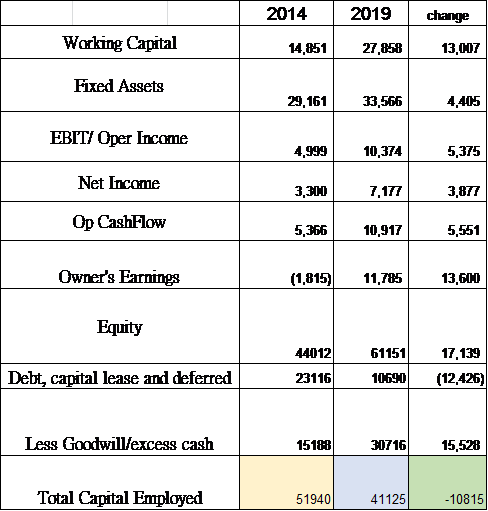
Koito’s owner’s earnings is 85B-90B yen or USD770M-800M. From
2014-2015, equity doubled. Capital employed, which included working capital and
fixed assets, is prudently employed by Koito. While working capital has
increased threefold from 108B yen to 330B, fixed assets only increased 28%,
from 114B yen to 158B yen. Koito has been cautious in Europe and understands
the shrinking demand in domestic production (Japan).
With a conservative growth rate of 3-4%, a discount rate of
15%, Koito would have to be at a market cap of USD5-6B to bring a greater
margin of safety. It is currently selling at USD9B. Koito should be selling
near 1400-1600Byen or USD13-14B. If Koito were to drop anywhere near USD 4-5B,
it would be a solid buy.
Koito intends to double China’s production, and bring up capacity
in Asia. Global utilization rates are only 70-75%, if Koito manages to bring
this up to 85% and if EBIT margins go up to 15-18%, it is possible for Koito to
reach over USD12billion in market capitalization.
While Koito’s market capitalization may seem expensive at USD8.97B, it has USD2.5B in cash and relatively little debt at USD272M,
which leaves us with an enterprise value of UD6.6B generating an operating
earning almost double of Stanley electric at USD890M. The multiple for
enterprise value to operating earnings is similar for both at 8x, but due to
Koito’s entrenched competitive advantage in Japan and connections with Toyota
with a double digit ROIC of 12-13% which has been sustained over more than a
decade, Koito provides better value at a similar multiple. Koito’s cash conversion cycle is the shortest
in the auto-lamp industry at 35 days. In terms of inventory turnover, Stanley
Electric is 32 days and Koito is 35 days. Japanese companies have inventory
turnover which is efficient than its European peers. Japanese auto-lamp
manufacturers Koito and Stanley Electric have the lowest debt to equity of its
peers at 7% and 5% respectively.

Catalyst
Despite not having the practice of repurchasing shares, management at Koito is disciplined and won’t over expand capital employed and won’t over-leverage, thus ensuring double digits for return on capital. Koito also has slight pricing power with connections to Japanese manufacturers, patents, and economies of scale which is sustainable for the next decade. Plans to increase production capacity in Mexico, Indonesia, China’s Fujian province and new factories in Brazil and Malaysia will eventually pay off when utilization rate is adequate.
Management paid
14.7B yen in dividends for 2019 when operating cash flow was 93.6B yen, which is
15% of total operating cash-flows.
Migration to LED automotive lamps from halogen and xenon
lighting will also bring higher margins. Koito plans to double the ratio of LED
headlamps to total headlamp shipments for overseas markets to 50% in five
years. Koito will develop LED headlamps with a simplified pricing structure,
and increase its LED headlamp production capacity in emerging markets
particularly electric vehicles in China.
Sources:
Koito Annual Report
Thai Stanley Annual Report
Stanley Electric Annual Report
Marklines.com
Chinese news articles from the Huayu breakup
Chinese news articles regarding Taiwan Daiyi cooperation